What is a work order?
A work order authorizes and describes a job: what to do, where, who does it, by when and at what cost. Types, what to include, and work order vs purchase order.
In short
- A work order is a document that authorizes a job and records everything about it: the task, location, assigned technician, materials, priority, deadline and cost.
- It usually starts as a work request. Once approved and staffed, the request becomes a work order.
- Common types are preventive (scheduled), corrective (fixing a fault), emergency, inspection and project work orders.
- A purchase order buys goods or services from a supplier; a work order tells someone to carry out a job. The finished work order is often the basis for the invoice.
A work order is the document that says: this job is approved, here is what to do, and here is who does it. IBM describes it as a document that includes all the details of a maintenance task and how it should be carried out. Afterwards it is the record of what was actually done.
From request to invoice
A work request is someone asking for work (“the AC in room 4 is not cooling”). It becomes a work order when someone with authority approves it and assigns people, tools and materials.
What a work order contains
- Work order number and date
- Customer or requesting department, and the job site
- Description of the work: the problem and what needs to be done
- Priority and scheduled or due date
- Assigned technician or crew
- Materials, parts and tools needed
- Estimated labor and cost
- Who authorized it
- Completion: actual time, parts used, notes, and a sign-off from the customer or supervisor
A filled-in example
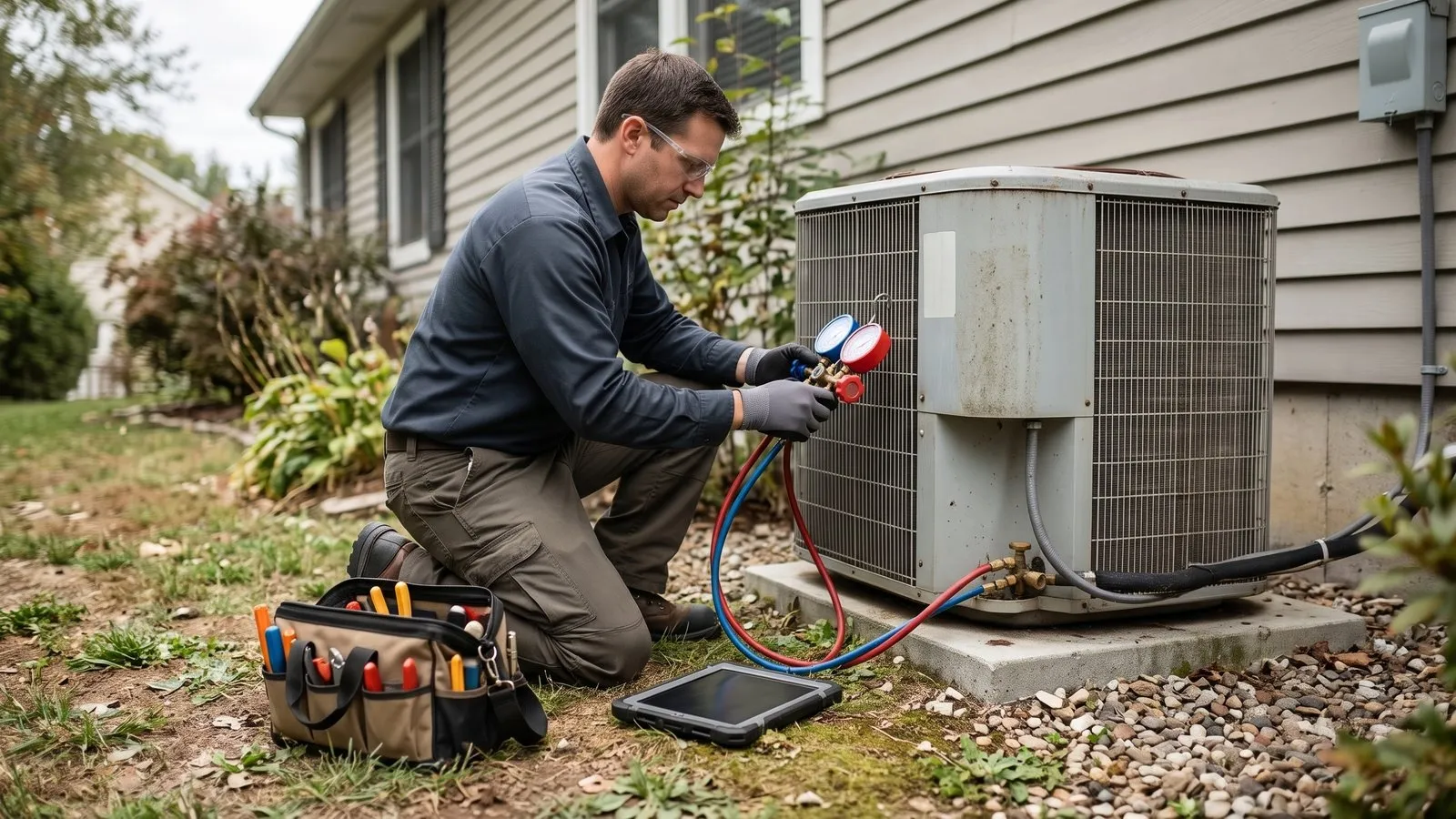
A small HVAC company gets a call: the air conditioning at a dental office is running but not cooling. The office manager approves a service visit, and the dispatcher writes this work order:
| Field | Entry |
|---|---|
| Work order | WO-2026-0418, created Nov 21, 2026 |
| Customer | Lakeside Dental, contact: office manager |
| Job site | 27 Oak Avenue, rooftop unit 2 |
| Description | Unit 2 runs but does not cool; office at 81°F. Diagnose, repair if parts are on the truck, otherwise quote. |
| Priority | Urgent: same day (patients in the building) |
| Assigned | Sam Rivera, service technician |
| Parts and tools | Gauges, capacitor kit, refrigerant leak detector |
| Estimate | Diagnostic call-out $89; repair to be quoted on site |
| Authorized by | Office manager, by phone, 9:40 am |
| Completion | Replaced failed 45/5 µF run capacitor; system cooling, supply air 56°F. 1.5 h on site. Customer signed 2:15 pm. |
The completion section is what the invoice is built from: the call-out fee, 1.5 hours of labor and one capacitor. Without it, the office has to piece the bill together from memory and text messages.
Writing a description a technician can act on
The description is the field most often written badly. Compare:
- Weak: “AC broken.”
- Useful: “Rooftop unit 2 runs but blows warm air since this morning. Thermostat set to 72°F, room at 81°F. Unit 1 is fine. Access via the roof hatch in the storage room; key at reception.”
A useful description says what is wrong, where exactly, since when, what has already been checked, and anything the technician needs to get in. For preventive work, list the tasks of the checklist instead, so the person doing it can tick them off.
Priority levels that people actually use
Many teams get by with three or four levels. One common scheme:
| Priority | Meaning | Typical response |
|---|---|---|
| Emergency | Safety risk, or the business cannot operate | Now |
| Urgent | Serious problem, but there is a workaround for a day | Same or next day |
| Normal | Needs fixing, no immediate impact | Within the week |
| Planned | Preventive or improvement work | Scheduled date |
Agree on what each level means with your customers or departments. If everything is marked urgent, the label stops meaning anything.
Types of work orders
| Type | When | Example |
|---|---|---|
| Preventive | On a schedule, before anything breaks | Quarterly filter change on rooftop units |
| Corrective | A fault was found, often before total failure | Replace a worn fan belt found during inspection |
| Emergency | Something failed and needs immediate repair | Burst pipe, no heat in winter |
| Inspection | To check condition or compliance | Annual fire damper inspection |
| Project | Larger one-off work | Install new lighting in the warehouse |
Work order vs. purchase order
A purchase order is sent by a buyer to a supplier to order goods or services at an agreed price. A work order directs someone, an in-house team or a contractor, to carry out a specific job. They often appear together: a facilities manager issues a purchase order to a contractor for a repair, and the contractor creates a work order for its technician. More in purchase order vs. invoice.
Closing the work order
A work order is not finished when the tools are packed. Before closing it:
- Record what was actually done, which can differ from what was requested.
- List parts and materials used, with quantities, so stock and billing are right.
- Enter the actual time on site, and travel time if you bill it.
- Note anything found that needs another job, and open a new work order for it rather than adding it to this one.
- Get the customer’s or supervisor’s sign-off.
- Send it to billing, or turn it into the invoice yourself.
If the customer asks for extra work in the middle of the job, write it down before doing it: a change order for contract work, or a new work order for service calls.
Create one with the work order template: job site, assigned technician, priority, a description field and a signature line for the customer when the work is done. Then turn it into an invoice with the same line items.
Frequently asked questions
Who creates a work order?
In a company, usually the maintenance or service manager after approving a request. A small service business often writes it itself when a customer calls, then has the customer sign it when the job is done.
Is a work order the same as an invoice?
No. The work order describes and authorizes the job. The invoice bills for it afterwards. Many trades use the signed work order, with actual hours and parts, as the basis for the invoice.
What is the difference between a work order and a job order?
The terms overlap. "Job order" is common in manufacturing and job costing; "work order" in maintenance and field service. Both describe a specific job to be done.
Sources
- What is a work order?, IBM
- Difference between corrective and preventive maintenance work orders, IBM Support
Photos are AI-generated illustrations; diagrams and tool screenshots are made from the PlanPrint tools. Something out of date or wrong? Tell us and we will correct it.