Invoice vs. receipt: what is the difference?
An invoice asks for payment; a receipt proves payment was made. When to use each, what each must show and how to write a receipt, with a side-by-side example.
In short
- An invoice comes before payment and asks for it. A receipt comes after payment and confirms it.
- An invoice shows what is owed and by when. A receipt shows what was paid, when, how, and any balance left.
- Many sales need only one: card and cash sales get a receipt on the spot; business-to-business work gets an invoice, and a receipt on request.
- Both are records worth keeping: the IRS lists invoices and receipts among the supporting documents for income and expenses.
The short version: an invoice asks to be paid; a receipt says you were paid. Same customer, same items, different moment.
Side by side
| Invoice | Receipt | |
|---|---|---|
| Purpose | Request payment | Confirm payment |
| Sent | After delivery (or for a deposit), before payment | After payment |
| Key amount | Total and balance due | Amount paid |
| Key date | Due date | Payment date |
| Shows how they paid | No (shows how to pay) | Yes: cash, card, check number, transfer |
| Typical for | Business customers, work billed later | Shops, cash sales, deposits, paid invoices |
When you need which
- A shop or market stall paid by card or cash: a receipt only.
- A freelancer or contractor billing after the job: an invoice. Send a receipt if the client asks, or if they paid in cash.
- A deposit: often both. An invoice asks for the deposit; a receipt confirms it arrived and shows the balance still to pay.
- A company client paying by bank transfer: the invoice, and their bank record is usually enough proof of payment. Some clients still want a receipt for their files.
How to write a receipt
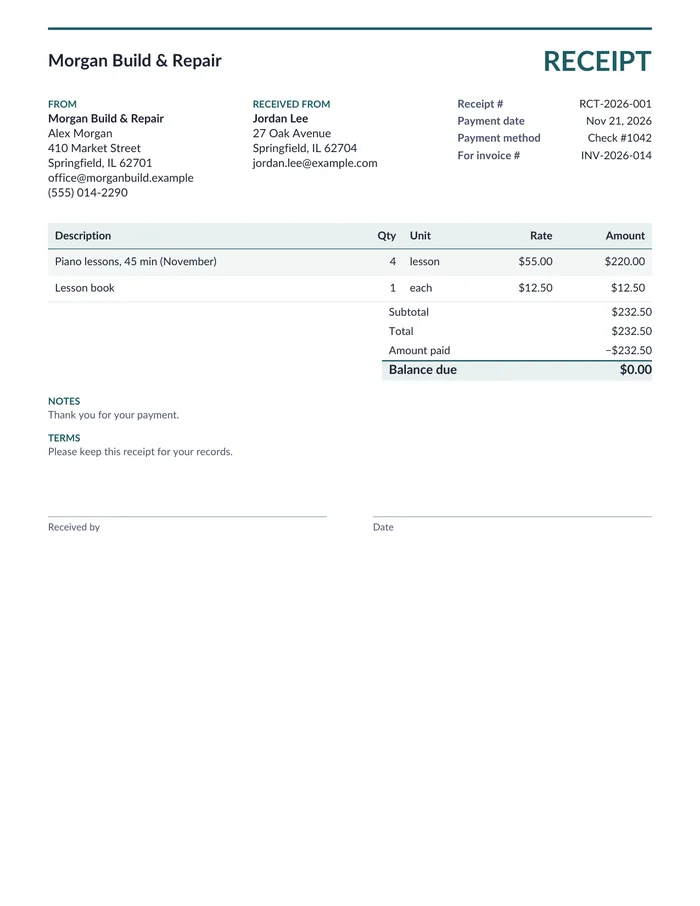
A useful receipt answers five questions: who paid, how much, for what, when, and how. Include:
- Your business name and contact details.
- A receipt number (RCT-0001, RCT-0002 …) and the payment date.
- The name of the person or company who paid.
- What the payment was for: the items, or “Payment for invoice INV-0042”.
- The amount paid and the method: cash, card, check number, bank transfer.
- The balance still due, if it was a partial payment.
- For cash, your signature.
A worked example: deposit, invoice and receipts
A kitchen fitter agrees a job for $4,800 with a 25% deposit. Here is the paperwork in order:
| Step | Document | Amount on it | Balance after |
|---|---|---|---|
| 1. Job agreed | Estimate EST-031, accepted | $4,800 total | – |
| 2. Before work starts | Invoice INV-0108 for the deposit | $1,200 due | $4,800 still open |
| 3. Deposit arrives | Receipt RCT-0057, “Payment for INV-0108”, check #2291 | $1,200 paid | $3,600 |
| 4. Job finished | Invoice INV-0115, total $4,800 less deposit received $1,200 | $3,600 due | $3,600 |
| 5. Final payment by transfer | Receipt RCT-0063, “Payment for INV-0115” | $3,600 paid | $0 |
Every receipt points to the invoice it pays, and the final invoice shows the deposit already received. Anyone looking at the file later, including you at tax time, can follow the money without guessing.
Receipt, sales receipt, payment receipt: same thing?
Mostly, yes. The names describe the situation more than the document:
- A sales receipt is issued at the moment of sale, when goods and payment change hands together (a shop, a market stall). There is no invoice before it.
- A payment receipt confirms a payment against something billed earlier, usually an invoice, and names it.
- A cash receipt is any receipt for cash. It is the one that most needs a signature and a number, because there is no bank record behind it.
- An acknowledgment of payment is a letter or email that says the same thing in sentences. It is fine for one-off cases, but a numbered receipt is easier to file and find.
Common mistakes
- Sending a receipt instead of an invoice. If the customer has not paid yet, the document is an invoice, whatever it is called on the page. A “receipt” with a balance due of the full amount confuses everyone.
- Leaving out the method. “Paid $350” is weaker proof than “Paid $350 by check #1042 on May 3”.
- No link to the invoice. When a customer pays several invoices, say which ones each payment covers, or the balances drift apart.
- Reusing numbers. Receipts need their own unbroken sequence, just like invoice numbers.
- Editing a paid invoice afterwards. If the price changes after payment, issue a new document (a credit note, refund receipt or new invoice) rather than changing the old one.
Keep both
Invoices and receipts are the paper trail behind your income and expenses. The IRS lists “sales slips, paid bills, invoices, receipts, deposit slips, and canceled checks” as supporting documents, so keep copies of the ones you issue and the ones you receive. In the EU, VAT invoices have their own required contents; a receipt does not replace a VAT invoice when the customer needs one to reclaim VAT.
Make either one in the same tool: the invoice template and the receipt template share your business details and line items, so you can turn a paid invoice into its receipt in one click.
Frequently asked questions
Is an invoice a proof of payment?
No. An invoice shows that money is owed. Proof of payment is a receipt, a bank or card statement, or a canceled check. An invoice marked "Paid" with the date and method can work as a receipt if both sides accept it.
Can a receipt replace an invoice?
For a simple sale paid on the spot, yes: the receipt is the only document. When a business customer needs to approve and pay later, they need an invoice first.
What should be on a receipt?
Your business name and contact, a receipt number, the payment date, who paid, what was paid for, the amount, the payment method, any balance still due, and for cash a signature.
Do I need to give a receipt for cash?
It is good practice for any cash payment, because neither side has a bank record of it. Give a numbered receipt and keep a copy.
Sources
- What kind of records should I keep, Internal Revenue Service (IRS)
- Invoicing rules (EU VAT), European Commission, Taxation and Customs Union
Photos are AI-generated illustrations; diagrams and tool screenshots are made from the PlanPrint tools. Something out of date or wrong? Tell us and we will correct it.